Airworthiness Requirements
- Airworthiness requirements are certificates and documents pilots must check on the aircraft to fly.
- It is like a checklist to confirm whether an aircraft is legally and physically fit to fly.
Objectives
To determine the applicant exhibits satisfactory knowledge, risk management, and skills associated with airworthiness requirements, including airplane certificates.
Purpose
- Just like cars, airplanes also have certificates such as registration certificates and insurance.
- Without these documents, the plane cannot legally fly.
Schedule
- Lesson: 20 min
- Q&A: 5 min
Reference
- PHAK Chapter 9
- FAR
ACS Standard
Knowledge: The applicant demonstrates understanding of:
PA.I.B.K1 General airworthiness requirements and compliance for airplanes, including:
PA.I.B.K1a a. Location and expiration dates of required aircraft certificates
PA.I.B.K1b b. Required inspections and airplane logbook documentation
PA.I.B.K1c c. Airworthiness Directives and Special Airworthiness Information Bulletins
PA.I.B.K1d d. Purpose and procedure for obtaining a special flight permit
PA.I.B.K1e e. Owner/Operator and pilot-in-command responsibilities
PA.I.B.K2 Pilot-performed preventive maintenance.
PA.I.B.K3 Equipment requirements for day and night VFR flight, including:
PA.I.B.K3a a. Flying with inoperative equipment
PA.I.B.K3b b. Using an approved Minimum Equipment List (MEL)
PA.I.B.K3c c. Kinds of Operation Equipment List (KOEL)
PA.I.B.K3d d. Required discrepancy records or placards
PA.I.B.K4 Standard and special airworthiness certificates and their associated operational limitations.
Risk Management: The applicant is able to identify, assess, and mitigate risk associated with:
PA.I.B.R1 Inoperative equipment discovered prior to flight.
Contents
- Aircraft documents
- Required documents
- Inspections
- Inoperative instruments
- Equipment requirements for day and night VFR flight
- Procedure of inoperative equipment
Aircraft Documents
Required Documents (ARROWPCS) [FAR 23.2100, 91.9, 91.203]
- Essential documents aircraft must carry
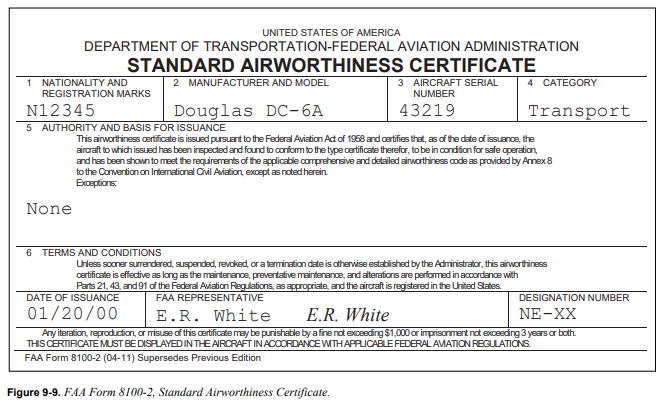
1) Airworthiness certificate [FAR 91.203]
- Airworthiness certificate is the certificate to prove whether the aircraft is airworthy or not [PHAK 3-2]
- Airworthiness certificate must be displayed in the aircraft for passengers and crew [91.203(2)(b)]
- It is issued by FAA [PHAK 3-2]
(1) Expiration period : X
- If the FAA judge like this aircraft is not airworthy, Airworthiness certificate will be expired
(2) Location : Airworthiness certificate must be displayed at the cabin or cockpit entrance visually for passengers or crew [FAR 91.203(b)]
(3) Standard and special airworthiness certificates
- Standard: remains in effect if the aircraft receives the required maintenance and is properly registered in the United States.
- Special: issued for all aircraft certificated in other than the Standard classifications, such as Experimental, Restricted, Limited, Provisional, and Light-Sport Aircraft (LSA)
2) Registration certificate [FAR 91.203]
- Registration certificate is the certificate to prove that aircraft owner own this aircraft
- Second copy of Registration certificate must be carried on the aircraft [FAR 91.203(2), 47.31(c)]
(1) Expiration [PHAK 9-6]
- 7 years after the last day of the month in which it is issued [FAR 47.40(a)]
- The aircraft is registered under the laws of a foreign country
- The aircraft’s registration is canceled upon written request of the certificate holder
- The aircraft is totally destroyed or scrapped
- The ownership of the aircraft is transferred
- The certificate holder loses United States citizenship
(2) Location : Baggage area
(3) Temporary Registration certificate : When the ownership is changed, we can use the Temporary registration certificate while Registration certificate is issued

3) Radio station license (International only) [47 CFR 87.18]
- If we are going to the International airport, we have to have a permit for operating the radio because different countries have different laws
- Pilot must also have the radio operator license
4) Operating limitations (In POH) [FAR 91.9]
5) Weight and balance (located in POH) [FAR 23.2620]
6) Placards (PIM section 2) [FAR 45.11]
7) Compass deviation card (IFR only) [FAR 21.1547]
8) Supplemental documents
Inspection
AVIATE [FAR 91.409 - 91.413]
1) Airworthiness directives(AD’s)
- Airworthiness directive is inspection to prove the aircraft whether it is airworthy or not [Advisory circular 39-7D, FAR 39.3, Read FAR 39]
(1) Type of AD’s
- Notice of Proposed Rulemaking(NPRM) followed by Final rule
- Final rule
- Emergency AD’s: The FAA will issue an Emergency AD when an unsafe condition exists that requires immediate action by an owner/operator
*How to find AD’s
- Manual searches
(2) AD’s intervals
- One-time AD: requires a one-time modification
- Recurring AD: requires a check or service to be performed on an ongoing basis at specific intervals
- N/A AD: a "not applicable AD," but is still noted to show awareness of its existence
2) Very high frequency omnidirectional range(VOR) [FAR 91.171]
- Period : every 30 days
- IFR only
- Can found in dispatch book
3) Inspection [FAR 91.409]
| Inspection | Aircraft | Mechanic | Supersede | Overfly |
| 100 hour | For hire only | A & P *Airframe and Power plant |
Can the 100 hours take the place of an Annual? No |
YES Just 10hours if we go to maintenance purpose |
| Annual | All aicraft | IA *Inspector Authorized |
Can the Annual take the place of a 100 hours? YES |
NO Unless we have a special flight permit from FSDO |
*Same list of inspection between 100 and annual, Mechanic is different [FAR Appendix D to part 43]
*Maintenance book 체크시 Aircraft 적혀있으면 Prop, Engine도 동시에 체크 진행한 것
(1) Progressive inspection
- Maintenance method to minimize maintenance downtime
- A progressive inspection allows for more frequent but shorter inspection phases, as long as all items required for the annual and 100-hour inspection are inspected within the required time.
E.g. Check engine today, Check cockpit next month, and complete all inspection
(1) Preventive maintenance
- Simple or minor preservation operations and replacement of parts not involving complex assembly like Tires, Shock absorber cords, Engine oil change etc [FAR 1.1]
- Preventive maintenance list [FAR Appendix A to Part 43(c)]
(2) Special flight permit
- Purpose : Repair, Deliver, Exporting aircraft, Test flight, Evacuating, Demonstration flight [FAR 21.197]
- How to get it? : Contact FSDO, Write the document, then FSDO will issue the special flight permit [FAR 39.25, FAR 21.199]
- If the FSDO does not work in holiday, we can call to designated airworthiness representative then can get the special flight permit
4) Altimeter/ Static
- Period : 24C.M
- IFR only
5) Transponder
- Period : 24C.M
6) Emergency Locator Transmitter(ELT) [FAR 91.207(a)(1)]
- Period : 12C.M [FAR 91.207 (d)]
- Replace batteries : 1/2 life of battery, 1 hour of use [FAR 91.207 (c) (1), (2)]
*When the ELT is not needed?-> Training flight within 50 NM [FAR 91.207 (e) (f)]
Dynamic Regulatory System
- DRS is the system consolidates information provided by various Services and Offices
- Pilots can find ADs, Type certificates data sheets, SBs, STC etc.
*DRS: https://drs.faa.gov/browse
1) Service bulletins [FAA, AC 20-176A]
- SB are notices to aircraft operators from a manufacturer notifying them of a product improvement.
- It is recommendation, not mandatory
- Pilots can search SBs on SAIB
(1) Special Airworthiness Information Bulletins (SAIB)
- Special Airworthiness Information Bulletin (SAIB) is an information tool that alerts, educates, and makes recommendations to the aviation community to improve the safety of a product
2) Supplemental type certificate (STC) [FAR 21.113]
- STC is type certificate issued when there are major change in type design under part 21.19
- Major change is the Proposed change in design, power, thrust, or weight [FAR 21.19]
- If the product manufacturer has received the STC, they can simply hand over the documents to the user for management, otherwise the user must obtain the STC directly from the FAA.
*ex) if the Cessna 172S engine is changed to same engine(IO-360-L2A), then STC is not required because there are no change of design, power, thrust, weight
3) Form 337 [Appendix B to Part 43]
- Kind of document to provide record information of major repair or alteration(AC 43.9-1F)
- Major repair and alteration [FAR Appendix A to Part 43(a), (b)]
Equipment requirements for day and night VFR flight
1. Day visual flight rules [FAR 91.205] TOMATO A FLAMES
- Tachometer(for each engine)
- Oil pressure gauge(for each engine using a pressure system)
- Manifold Pressure gauge(for altitude engine)
- Airspeed indicator
- Temperature gauge(for each liquid cooled engine)
- Oil temperature gauge(for each air cooled engine)
- Altimeter
- Fuel quantity gauge(Each tank)
- Landing gear position(for aircraft that has retractable landing gear)
- Anti collision light(march 11, 1996)
- Magnetic compass
- ELT(Emergency locator transmitter)
- Safety belts(with shoulder harnesses if manufactured after July 18, 1978, Pilots : all time, passengers : taxi, take off, landing)
2. Night visual flight rules [FAR 91.205] FLAPS
- Fuses(one complete spare set, but we use circuit breakers so we don’t need fuses)
- Landing light(hire only)
- Anti- collision light(August 11, 1971)
- Position light(nav light -> sunset to sunrise)
- Source of electrical power(Alternator is main, Battery is secondary)
*If the battery doesn’t work or doesn’t have a battery, can not fly at night because alternator charge the battery and battery supply the current to device
Inoperative instruments and equipment
Procedure of Inoperative equipment [FAR 91.213]
- 1st , Check the FAR 91.213, Follow the procedure
- Check the MEL
- If we don’t have and MEL, Follow the 9TAP rules
1) 91.205 (DAY Visual flight rules)
2) Type certificate data sheet(VFR day type certificate, FAA.GOV)
3) AD’s
4) POH Equipment list(Kinds of operation equipment list) [PIM section 6-17, 2-12]
- Required equipment: “1”, Non-required equipment: “0”, refer to note: “*”
5) After check,
- Remove or deactivate the instrument and equipment, and
- Post the inoperative placard,
- Pilot decision
*Any inoperative instrument or item of equipment, permitted to be inoperative by § 91.213(d)
(2) of this part, repaired, replaced, removed, or inspected at the next required inspection. [FAR 91.405(c)]
2) Minimum Equipment List(MEL) [PHAK 9-10]
- MEL is a Minimum Equipment List.
- It is procedures that allows an aircraft to be operated with inoperative equipment
- When the manufacturer made the aircraft, The local FSDO may issue the Master Minimum Equipment List(MMEL) if it is needed
- MMEL is the inoperative procedure for basic model of aircraft
- But all aircraft have different instrument and equipment, so operator request MEL to the FSDO, FSDO may issue the Letter of Authorization(LOA) and Preamble
- Then operator develops operations and maintenance(O&M) procedure from the MMEL and report it to the FAA
- Then FAA issue the MEL for operator
- The MEL, Preamble, and O&M must be on board the aircraft during each operation.
'Private Pilot (ACS) > I. Preflight Preparation' 카테고리의 다른 글
| Task A. Pilot Qualifications (0) | 2025.08.26 |
|---|