Pilot Qualifications
- Pilot qualifications are a process of verifying the licenses, documents, and qualifications required for a pilot to fly.
- It is like a checklist to confirm whether a pilot is legally and physically fit to fly.
Objectives
- To determine the applicant exhibits satisfactory knowledge, risk management, and skills associated with airman and medical certificates including privileges, limitations, currency, and operating as pilot-in-command as a private pilot.
Purpose
- Just like drivers must follow road rules for safety, pilots must follow aviation laws and regulations
- It includes things like having the right certificates, being familiar with the aircraft, and meeting the physical standards required to safely operate a flight.
- Understanding these qualifications ensures that pilots fly legally and responsibly under FAA regulations.
Schedule
- Lesson: 20 min
- Q&A: 5 min
Reference
- 14 CFR 1, 61
- PHAK Chapter 17
ACS Standard
Knowledge: The applicant demonstrates understanding of:
PA.I.A.K1 Certification requirements, recent flight experience, and recordkeeping.
PA.I.A.K2 Privileges and limitations.
PA.I.A.K3 Medical certificates: class, expiration, privileges, temporary disqualifications.
PA.I.A.K4 Documents required to exercise private pilot privileges.
PA.I.A.K5 Part 68 BasicMed privileges and limitations.
Risk Management: The applicant is able to identify, assess, and mitigate risk associated with:
PA.I.A.R1 Proficiency versus currency.
PA.I.A.R2 Flying unfamiliar aircraft or operating with unfamiliar flight display systems and avionics
Contents
- Certificate and Documents
- Required certificate
- Medical certificate
- Recordkeeping
- Pilot logbooks
- Recent flight experience
Certificate and Documents
- Essential documents they must carry to legally operate an aircraft.
PIM [14 CFR 61.3]
1. Pilot certificate
- Student pilot
- Sports pilot
- Recreational pilot
- Private pilot
- Commercial pilot
- Flight instructor
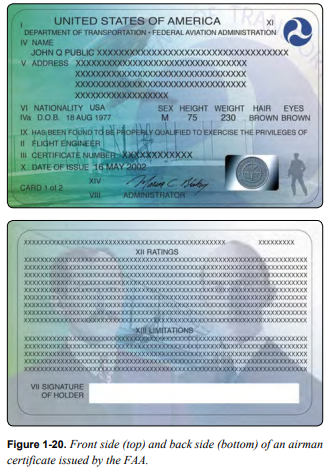
2. Photo ID issued by government
- Passport
- Drivers license (Check FAA approved)
- Military ID card
- etc
3. Medical certificate
- 1st
- 2nd
- 3rd
Eligibility
1. Student pilot eligibility [14 CFR 61.83]
(a) Student pilot certificate, an applicant must be at least 16 years old
(c) Applicant must be able to read, speak, write, and understand the English language
2. Private pilot eligibility [14 CFR 61.103]
To be eligible for a private pilot certificate, a person must:
(a) Be at least 17 years of age
(c) Be able to read, speak, write, and understand the English language.
(d) Receive a logbook endorsement from an authorized instructor
(e) Pass the required knowledge test on the aeronautical knowledge areas
(h) Pass a practical test on the areas
(j) Hold a U.S. student pilot certificate, sport pilot certificate, or recreational pilot certificate.
*Authorized instructor [14 CFR 61.1]: Ground instructor, Flight instructor
Privileges and limitations
1. Student pilot privileges and limitations [14 CFR 61.89]
(a) A student pilot may not act as pilot in command of an aircraft:
(1) That is carrying a passenger;
(2) That is carrying property for compensation or hire;
(3) For compensation or hire;
(4) In furtherance of a business;
(5) On an international flight, except that a student pilot may make solo training flights from Haines, Gustavus, or Juneau, Alaska, to White Horse, Yukon, Canada, and return over the province of British Columbia;
(6) With a flight or surface visibility of less than 3 statute miles during daylight hours or 5 statute miles at night;
(7) When the flight cannot be made with visual reference to the surface; or
(8) In a manner contrary to any limitations placed in the pilot's logbook by an authorized instructor.
*Student pilot solo requirements [14 CFR 61.87]
(b) A student pilot must demonstrate satisfactory aeronautical knowledge on a knowledge test
(c) A student pilot must have received and logged flight training for the maneuvers and procedures
(n) A student pilot may not operate an aircraft in solo flight unless that student pilot has received an endorsement
2. Private pilot privileges and limitations [14 CFR 61.113]
(a) May not act as pilot in command of an aircraft that is carrying passengers or property for compensation or hire
(b) May act as pilot in command for compensation or hire with any business or employment
(c) May not pay less than the pro rata share
(d) May act as pilot in command of a charitable, nonprofit, or community event flight
(e) May be reimbursed for aircraft operating expenses
(f) May demonstrate an aircraft in flight to a prospective buyer (at least 200 hours of flight time)
(g) May act as a pilot in command of an aircraft towing a glider or unpowered ultralight vehicle (requirements: § 61.69)
Change of address [14 CFR 61.60]
If a pilot changes their permanent mailing address, they must notify the FAA within 30 days. Otherwise, they may not exercise the privileges of their pilot certificate after that period.
To update your address, you can either:
- Submit the change online via the FAA website
- Or send a written notice to:
FAA, Airman Certification Branch
P.O. Box 25082
Oklahoma City, OK 73125
Medical certificates
What is the medical certificate? [14 CFR 1.1]
- Medical certificate is acceptable evidence of physical fitness on a form prescribed by the administrator.
- In simpler terms, it’s official proof that a pilot is healthy enough to fly safely.
Why do we need a medical certificate?
- Imagine a pilot with serious vision problems—they wouldn’t be able to see surrounding traffic in the air, making it impossible to avoid a potential collision.
- This is exactly why medical certificates are important: they confirm that a pilot meets the physical standards required to operate an aircraft safely and protect both themselves and others.
Class of Medical certificate [14 CFR 61.23]
- Pilots must hold a valid medical certificate to exercise the privileges of their airman certificate.
| Class | Privileges | Under age 40 | Age 40 or older |
| 1st | ATP | 12 CM | 6 CM |
| COM | 12 CM | 12 CM | |
| PVT & CFI | 60 CM | 24 CM | |
| 2nd | COM | 12 CM | 12 CM |
| PVT & CFI | 60 CM | 24 CM | |
| 3rd | PVT & CFI | 60 CM | 24 CM |
*A higher-class grants the privileges of a lower-class
How do we get an appropriate medical certificate?
1. Find an AME near you using the FAA’s official locator.
*Find an Aviation Medical Examiner (AME): https://www.faa.gov/pilots/amelocator/
2. Complete Form 8500-8 through the MedXPress system.
*MedXpress website: https://medxpress.faa.gov/
Disqualifying Conditions [PHAK 17-2, FAA consider disqualifying]
According to 14 CFR Part 67, the FAA identifies 15 medical conditions that are considered disqualifying based on your medical history or clinical diagnosis.
- Angina Pectoris
- Bipolar Disorder
- Cardiac Valve Replacement
- Coronary Heart Disease that has been treated or, if untreated, that has been symptomatic or clinically significant
- Diabetes Mellitus requiring hypoglycemic medication
- Disturbance of Consciousness without satisfactory explanation of cause
- Epilepsy
- Heart Replacement (Cardiac Transplant)
- Myocardial Infarction
- Permanent cardiac pacemaker
- Personality Disorder that is severe enough to have repeatedly manifested itself by overt acts
- Psychosis
- Substance Abuse
- Substance Dependence
- Transient Loss of Control of Nervous System function(s) without satisfactory explanation of cause
⚠️ Important:
Having one of these conditions does not always mean permanent disqualification. In many cases, pilots may receive a Special Issuance or a Statement of Demonstrated Ability (SODA) if the FAA determines that the condition is under control and does not pose a safety risk.
1. Can you still fly with a disqualifying condition? [14 CFR 67.401]
1) Special Issuance of medical certificate
- If your condition has been treated or well-controlled, and it no longer poses a safety risk, the FAA may issue a Special Issuance medical certificate.
(1) What to expect:
- You’ll likely need to provide detailed medical records and undergo evaluation by an FAA-designated specialist.
- The certificate is granted at the discretion of the Federal Air Surgeon, and may be issued for a limited time (e.g., 6–12 months).
- You must renew it regularly with updated medical evaluations.
This option is commonly used for conditions like treated heart disease, diabetes, or mental health disorders that are stable and under control.
2) Statement of Demonstrated Ability (SODA)
- This is for pilots who have a physical disability (e.g., missing a limb or partial vision in one eye), but can prove they can safely operate an aircraft.
(1) Key points:
- SODA is issued after a practical evaluation with an FAA inspector or designated examiner.
- It doesn’t expire—as long as your medical condition remains unchanged.
- This pathway recognizes ability over impairment—great news for many pilots.
2. Can you still fly without an FAA medical certificate?
- BasicMed, certain pilots can fly without holding a traditional FAA medical certificate.
1) What is BasicMed?
BasicMed is an alternate way for pilots to fly without holding an FAA medical certificate
2) How to get it?
- Print off a FAA Form 8700-2; BasicMed Comprehensive Medical Examination Checklist (CMEC) and get your physical exam with a state-licensed physician.
- Complete an online medical course
3) What kind of aircraft can you fly?
- Any aircraft authorized under federal law to carry not more than 7 occupants
- Has a maximum certificated takeoff weight of not more than 12,500 pounds
4) BasicMed Operating Limits
- Carries not more than six passengers
- Operates under VFR or IFR, within the United States, at or below 18,000 feet MSL, not exceeding 250 knots.
- Flight not operated for compensation or hire
Recordkeeping
- Keeping an accurate logbook is a legal requirement under 14 CFR § 61.51.
- Logbook is official proof of training, flight experience, and qualifications.
Pilot logbooks [14 CFR 61.51]
(a) Each person must document and record the following time in a manner acceptable to the Administrator:
(1) Training and aeronautical experience used to meet the requirements for a certificate, rating, or flight review of this part.
(2) The aeronautical experience required for meeting the recent flight experience requirements of this part.
(b) Logbook entries.
- Day or Night
- Total time
- Duel time
- Instrument
- PIC
- etc
(e) Logging pilot-in-command flight time.
- Pilot in command(PIC) is the person who has final authority and responsibility for the operation and the safety of the flight
- When the pilot is the sole manipulator who has rating of that aircraft
- When the pilot has sport pilot privileges for that category and class of aircraft
- When the pilot is the sole occupant in the aircraft
- When the pilot performs the duties of pilot in command while under the supervision of a qualified pilot in command
Recent flight experience [14 CFR 61.2 (b)]
If pilots are not used to flying, it can lead to mistakes.
- Might not recognize the layout of the avionics
- Mistake while scanning the instruments
- Difficult to follow ATC instructions
- Manage the aircraft safely.
*That’s why maintaining flight proficiency is essential. Pilots must log their flight time in a logbook to demonstrate experience and readiness.
There are two key terms to understand:
- Currency: The legal minimum requirements to act as a pilot (e.g., recent takeoffs and landings).
- Proficiency: Your actual skill level and how comfortable you are flying.
Currency requirements
1. Flight review [14 CFR 61.56]
To act as Pilot in Command (PIC), you must complete a flight review every 24 calendar months with an authorized instructor.
The review includes:
- At least 1 hour of ground training
- At least 1 hour of flight training
- Conducted in an aircraft that the pilot is rated for (same category and class, and type rating if required)
2. Recent Flight Experience (for PIC) [14 CFR 61.57]
To carry passengers, you must have performed:
- 3 takeoffs and 3 landings within the past 90 days
- In an aircraft of the same category and class (and type if applicable)
- For night flying or tailwheel airplanes, landings must be full stop
*Bonus Tip: If you make a night landing, it also counts toward day currency!
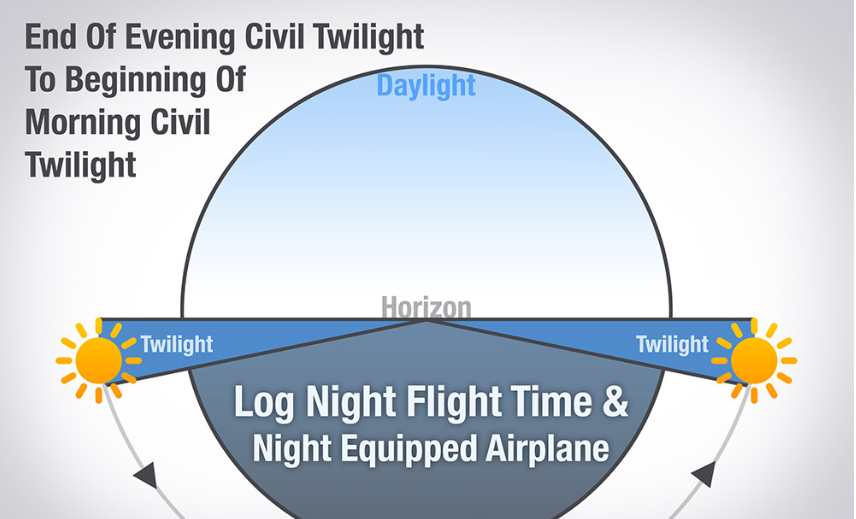
1) What Counts as Night? [14 CFR 1.1]
The FAA has specific definitions for night operations:
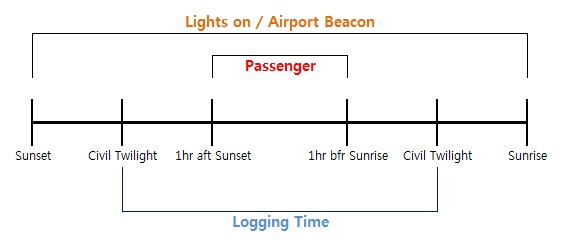
- The time between the end of evening civil twilight and the beginning of morning civil twilight
- When the sun is 6° below the horizon
 |
 |
(1) Sunset to Sunrise [14 CFR 91.209]
Pilot must turn on navigation lights
(2) Night (Between Civil twilight)
Pilots can log the Night time on their logbook
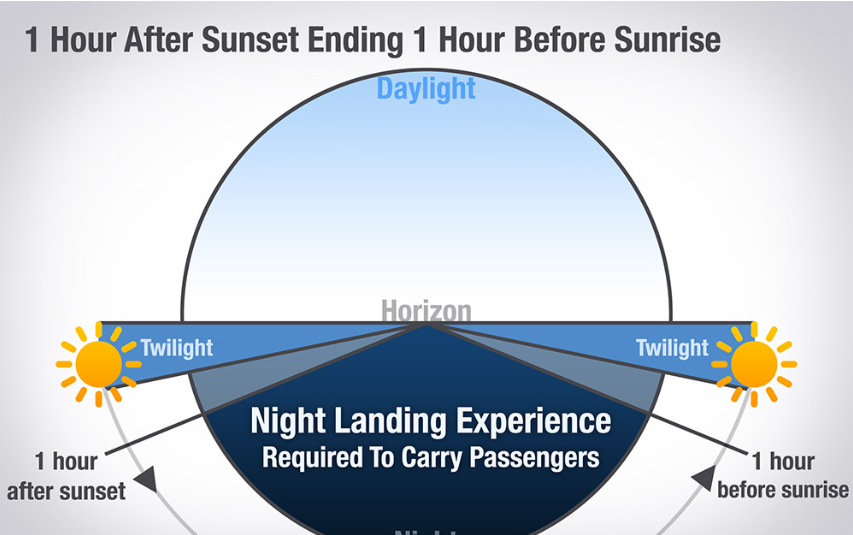
(3) Log Night landing [14 CFR 61.57(b)]
Pilot must have made 3 full-stop takeoffs and landings between 1 hour after sunset and 1 hour before sunrise within the last 90 days to carry passengers at night.
Aircraft transition
Even experienced pilots can get into trouble when flying an unfamiliar aircraft. A lack of proficiency in a specific airplane can lead to loss of aircraft control, reduced situational awareness, or even accidents. That’s why transitioning to a new type of aircraft requires specific training, covering normal, abnormal, and emergency procedures.
Let’s break down the FAA’s guidelines for transitioning to different kinds of aircraft:
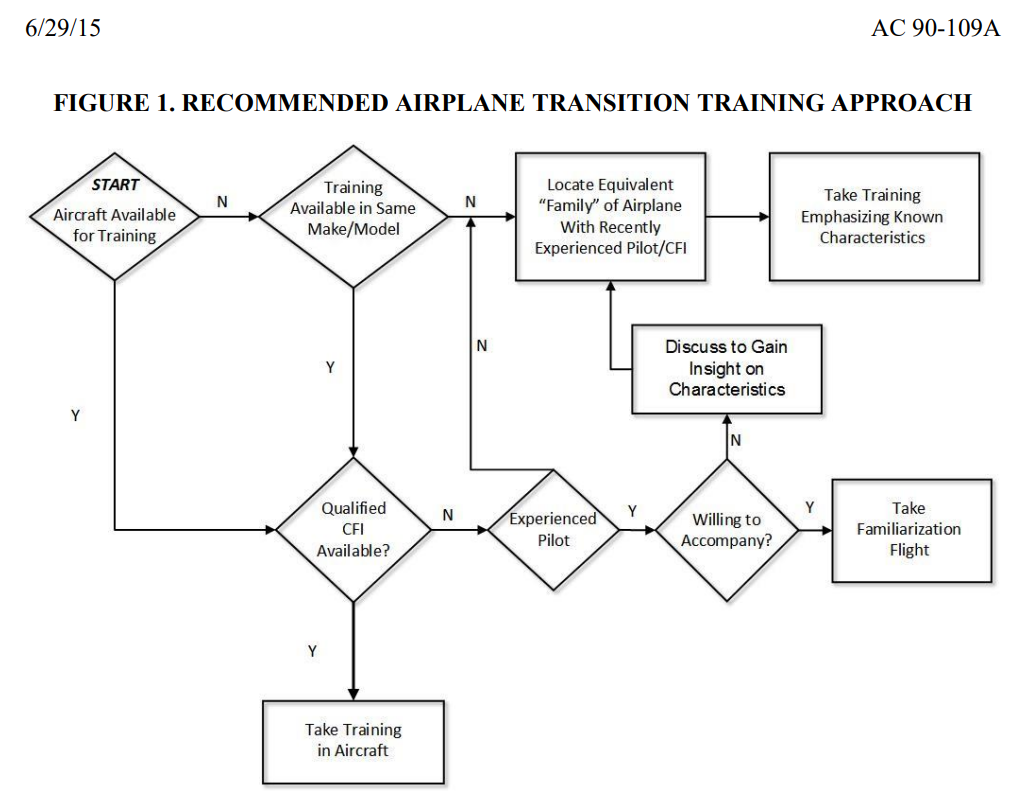
1. Type Ratings – When Are They Required? [14 CFR 61.31]
(a) A person who acts as a pilot in command of any of the following aircraft must hold a type rating for that aircraft:
(1) Large aircraft (except lighter-than-air).
(2) Turbojet-powered airplanes.
(3) Powered-lift.
(4) Other aircraft specified by the Administrator through aircraft type certificate procedures.
*Large aircraft is the aircraft that maximum certificated takeoff weight is more than 12,500lb [FAR 1.1]
2. Special Aircraft Categories Requiring Endorsements [14 CFR 61.31]
1) Complex airplane
Complex airplane is the airplane that have flaps, adjustable pitch propeller and retractable landing gear including engine control system [FAR 61.1]
To act as PIC, you must:
- Complete and log ground and flight training with an authorized instructor
- Receive a one-time logbook endorsement
*You can train in the actual aircraft, a full flight simulator, or a flight training device.
2) High performance airplane
High performance airplane is the airplane with an engine of more than 200hp
Example
- Piper Arrow is not high performance because it is just 200 hp engine
- Piper Seminole is also not high performance because it have 2 × 180 hp engine
To act as PIC, you must:
- Complete and log ground and flight training with an authorized instructor
- Receive a one-time logbook endorsement
3) Pressurized aircraft
Pressurized aircraft is an aircraft that has a service ceiling or maximum operating altitude and lower one is above 25,000 ft MSL
To act as PIC, you must:
- Complete and log ground and flight training with an authorized instructor
- Receive a one-time logbook endorsement
4) Tailwheel airplane
Tailwheel airplanes handle differently during takeoff and landing.
To act as PIC, you must:
- Complete and log ground and flight training with an authorized instructor
- Receive a one-time logbook endorsement
'Private Pilot (ACS) > I. Preflight Preparation' 카테고리의 다른 글
| Task B. Airworthiness Requirements (0) | 2025.08.26 |
|---|